Supply Chain Attack Prevention Best Practices Every Team Should Know
Table of Contents
- Table of Contents
- The Anatomy of a Modern Software Supply Chain Attack
- Core Pillars of Supply Chain Attack Prevention
- Implementing Zero Trust in Your CI/CD Pipeline
- Third-Party Risk Management and Dependency Auditing
- Continuous Monitoring and Automated Remediation
- Securing Your Software Supply Chain in the AI Era
- Frequently Asked Questions
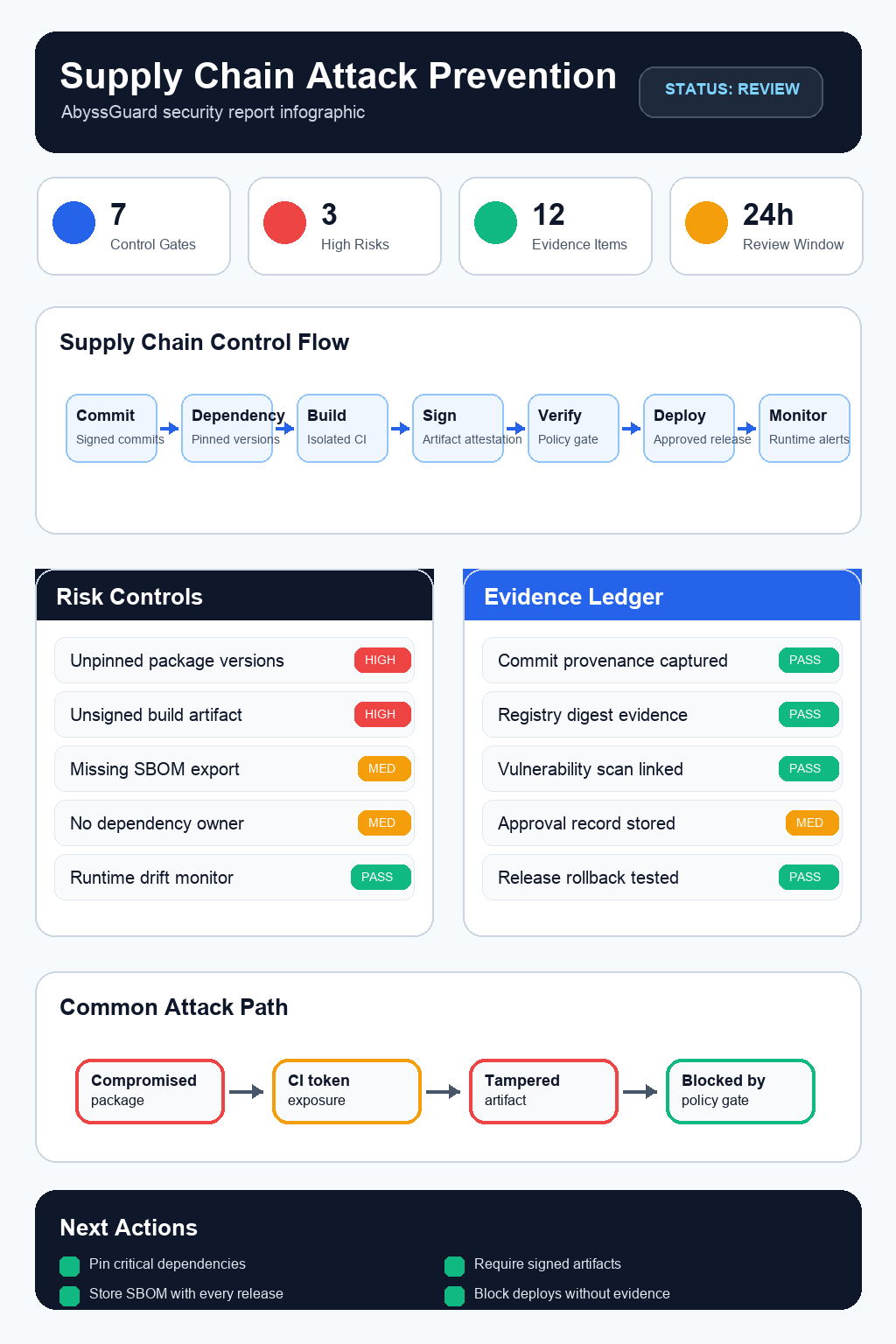
- Enforce cryptographic provenance across all build artifacts, as industry data shows unsigned binaries are 4.5 times more likely to be exploited in downstream attacks.
- Mandate dynamic SBOM generation for every release, ensuring complete visibility into the 80-90% of modern codebases comprised of third-party open-source dependencies.
- Eliminate long-lived pipeline secrets by adopting ephemeral, OIDC-based authentication, reducing the blast radius of compromised CI/CD credentials to zero.
- Implement AI-driven anomaly detection in your build environment to identify unauthorized behavioral shifts that bypass traditional static application security testing (SAST).
- Transition to immutable build infrastructure using ephemeral runners, preventing persistent backdoors from surviving across consecutive deployment cycles.
Table of Contents
1. The Anatomy of a Modern Software Supply Chain Attack
2. Core Pillars of Supply Chain Attack Prevention
3. Implementing Zero Trust in Your CI/CD Pipeline
4. Third-Party Risk Management and Dependency Auditing
5. Continuous Monitoring and Automated Remediation
6. Securing Your Software Supply Chain in the AI Era
The Anatomy of a Modern Software Supply Chain Attack
A software supply chain attack occurs when a threat actor infiltrates the software development lifecycle to inject malicious code, compromise build tools, or hijack distribution mechanisms. Unlike traditional cyberattacks that target an organization's external defenses, supply chain attacks exploit the inherent trust organizations place in their vendors, open-source libraries, and internal development tools. The objective is rarely the immediate target; rather, it is to achieve widespread, silent distribution of malware or backdoors to downstream customers. As development practices have evolved to prioritize speed and continuous integration, the attack surface has expanded exponentially, making robust supply chain attack prevention a critical business imperative.
The Shift from Perimeter to Pipeline
Historically, security teams focused heavily on network perimeters and application firewalls. Today, the most lucrative targets for advanced persistent threats (APTs) are the tools that build and deploy the software. Attackers routinely target source code repositories, package registries (like npm, PyPI, and RubyGems), and CI/CD orchestration platforms (such as Jenkins, GitHub Actions, and GitLab CI). By compromising a single pipeline component, an attacker can silently inject malicious payloads into every subsequent build. This shift means that a vulnerability in your build script is just as critical as a SQL injection in your production database. Effective supply chain attack prevention requires treating the CI/CD pipeline with the same level of paranoia and scrutiny as your production environment.
High-Profile Breaches and the Cost of Inaction
The devastating impact of supply chain compromises is well-documented. The SolarWinds Orion breach demonstrated how compromising a single software update mechanism could grant attackers access to over 18,000 organizations, including multiple government agencies. Similarly, the Codecov bash uploader compromise allowed attackers to harvest environment variables and secrets from thousands of CI/CD pipelines. According to the Verizon Data Breach Investigations Report (DBIR), supply chain and third-party breaches now account for a significant and rapidly growing percentage of total enterprise incidents. The financial and reputational costs of inaction are staggering, often resulting in multi-million dollar remediation efforts, regulatory fines, and irreversible loss of customer trust.
Core Pillars of Supply Chain Attack Prevention
Effective supply chain attack prevention is not achieved through a single tool, but through a layered architectural strategy. The standard approach requires integrating security natively into the development lifecycle, ensuring that every artifact produced is verifiable, traceable, and untampered. According to the NIST Secure Software Development Framework (SSDF), organizations must establish secure build environments, protect software integrity, and verify the provenance of all third-party components. Moving from a state of uncertainty to cryptographic certainty requires adopting modern frameworks that enforce transparency and accountability at every stage of the software delivery process.
Cryptographic Signing and Provenance
To ensure that code has not been altered between the commit and deployment phases, organizations must implement cryptographic signing for all build artifacts. Frameworks like the Supply-chain Levels for Software Artifacts (SLSA) provide a standardized checklist to protect against tampering. By utilizing tools like Sigstore, development teams can automatically sign container images, binaries, and software packages, generating verifiable provenance metadata. This metadata proves exactly who built the artifact, what source code was used, and which build environment executed the process. If an artifact lacks a valid, verifiable signature, the deployment pipeline must automatically reject it. This binary approach—verified or uncertain—eliminates the risk of deploying compromised or unofficial builds.
Software Bill of Materials (SBOM) Mandates
You cannot secure what you cannot see. A Software Bill of Materials (SBOM) is a formal, machine-readable inventory detailing every component, library, and dependency within a software product. Following the U.S. Executive Order on Improving the Nation's Cybersecurity, generating an SBOM has transitioned from a best practice to a strict mandate for many industries. Utilizing standardized formats like CycloneDX or SPDX allows security teams to instantly cross-reference their dependencies against newly published Common Vulnerabilities and Exposures (CVEs). When a zero-day vulnerability is disclosed in a widely used logging library, an accurate SBOM enables teams to identify affected applications in minutes rather than weeks, drastically reducing the mean time to remediate (MTTR).
Immutable Infrastructure and Build Environments
Persistent build servers are a massive liability. If an attacker gains access to a long-lived Jenkins master or a shared GitLab runner, they can install persistent backdoors, modify global configurations, and compromise every future build. Supply chain attack prevention demands the use of immutable, ephemeral build infrastructure. By spinning up a fresh, isolated container for every single build job and destroying it immediately upon completion, you eliminate the possibility of cross-contamination between builds. This ensures that the build environment is always in a known, secure state, preventing attackers from maintaining a foothold within your CI/CD pipeline.
Implementing Zero Trust in Your CI/CD Pipeline
Zero Trust architecture dictates that no user, system, or service should be implicitly trusted, regardless of its location within the network. While most organizations have applied Zero Trust principles to their corporate networks and cloud infrastructure, they frequently fail to apply them to their CI/CD pipelines. In a modern development environment, the pipeline possesses the "keys to the kingdom," holding the credentials required to deploy code to production, access cloud infrastructure, and pull from private registries. Implementing Zero Trust in your pipeline is a non-negotiable requirement for comprehensive supply chain attack prevention, ensuring that every action is authenticated, authorized, and continuously validated.
Secret Management and Access Controls
The most common vector for pipeline compromise is the exposure of long-lived credentials. Hardcoded API keys, static cloud provider tokens, and unencrypted database passwords stored in repository variables are prime targets for attackers. To secure the pipeline, organizations must eliminate long-lived secrets entirely. Instead, adopt dynamic secret management solutions like HashiCorp Vault or AWS Secrets Manager, which generate short-lived, just-in-time credentials that expire immediately after the build job completes. Furthermore, enforce strict least-privilege access controls. A pipeline building a frontend React application should never possess the IAM permissions required to modify backend database schemas. By segmenting access and utilizing OpenID Connect (OIDC) for federated authentication, you ensure that compromised pipeline credentials have a blast radius of zero.
Ephemeral Build Agents and Isolation
Building on the concept of immutable infrastructure, Zero Trust requires strict isolation between build agents. When utilizing shared runners, a malicious or compromised build job could potentially access the memory, file system, or network traffic of a concurrent build job running on the same host. To prevent this, enforce strict tenant isolation by utilizing ephemeral, single-use build agents hosted in isolated virtual machines or secure microVMs (like Firecracker). Additionally, restrict the network egress of your build agents. A build agent should only be able to communicate with approved package registries and internal artifact repositories. Blocking arbitrary outbound internet access prevents malicious build scripts from exfiltrating source code or downloading unauthorized payloads during the compilation phase.
Third-Party Risk Management and Dependency Auditing
Modern software is largely assembled, not written from scratch. With open-source components comprising the vast majority of contemporary codebases, your application's security posture is inextricably linked to the security practices of thousands of external maintainers. Third-party risk management is the process of identifying, assessing, and mitigating the vulnerabilities introduced by these external dependencies. Effective supply chain attack prevention requires shifting the security evaluation left, ensuring that no third-party code enters your environment without rigorous, automated validation.
Open Source Vulnerability Scanning
Relying on manual reviews or periodic audits for open-source dependencies is a failing strategy. Development teams must integrate automated Software Composition Analysis (SCA) tools directly into their pull request workflows. These tools scan the dependency tree—not just the direct dependencies, but the transitive dependencies nested deep within the project—to identify known vulnerabilities, malicious packages, and license compliance issues. However, identifying a vulnerability is only half the battle. Security teams must differentiate between a vulnerability that is merely present in the codebase and one that is actually exploitable in the runtime environment. By combining SCA with reachability analysis, teams can prioritize remediation efforts on the critical paths, reducing alert fatigue and accelerating secure delivery.
Vendor Security Posture Assessments
Beyond open-source libraries, development teams rely on a vast ecosystem of SaaS tools, cloud services, and third-party APIs. Every integration represents a potential supply chain vulnerability. Vendor security posture assessments must be conducted before onboarding any new tool into the development lifecycle. This involves evaluating the vendor's SOC 2 compliance, their incident response capabilities, and their own supply chain security practices. If a third-party code scanning tool requires read/write access to your source code repositories, a breach of that vendor could result in the theft of your intellectual property. Continuous monitoring of your vendors' security postures ensures that you are alerted immediately if a trusted partner's risk profile degrades.
Continuous Monitoring and Automated Remediation
Prevention strategies establish a secure baseline, but continuous monitoring ensures that the baseline is maintained over time. The threat landscape is highly dynamic; a dependency that is secure today may be compromised tomorrow through a maintainer account takeover or a newly discovered zero-day. Continuous monitoring and automated remediation transform supply chain attack prevention from a periodic checklist into an always-on, autonomous defense mechanism. This is where advanced, AI-driven platforms like AbyssGuard deliver transformative value, bridging the gap between static analysis and dynamic, real-time threat mitigation.
AI-Driven Anomaly Detection
Traditional security tools rely on known signatures and predefined rules, making them blind to novel, logic-based attacks or subtle behavioral anomalies. AbyssGuard leverages advanced machine learning models to establish a behavioral baseline for your CI/CD pipeline and development workflows. By analyzing build logs, commit patterns, and network telemetry, the AI can detect anomalies that indicate a supply chain compromise. For example, if a build process that typically takes three minutes and downloads 50 megabytes of dependencies suddenly takes fifteen minutes and initiates an outbound connection to an unknown IP address, AbyssGuard immediately flags the anomaly and halts the deployment. This proactive detection stops sophisticated attacks, such as dependency confusion or cryptomining injections, before they reach production.
Automated Penetration Testing in the Pipeline
Static Application Security Testing (SAST) and SCA are essential, but they only verify the theoretical security of the code. To ensure the application is truly production-ready, teams must validate its security in a running state. AbyssGuard integrates automated, AI-guided penetration testing directly into the CI/CD pipeline. Unlike legacy dynamic analysis tools that generate high volumes of false positives, AbyssGuard's AI intelligently maps the application's attack surface and executes targeted, context-aware exploits. If the AI successfully chains a minor misconfiguration with a third-party library flaw to achieve remote code execution, it automatically generates a detailed remediation ticket with the exact code fix required. This ensures that every release is dynamically validated against real-world attack vectors.
Securing Your Software Supply Chain in the AI Era
The era of trusting your build pipeline by default is over. As threat actors increasingly weaponize AI to automate the discovery of vulnerable dependencies and orchestrate complex supply chain attacks, development teams must respond with equally advanced, automated defenses. Supply chain attack prevention is no longer just a security initiative; it is a fundamental requirement for engineering excellence and business continuity.
By enforcing cryptographic provenance, mandating dynamic SBOMs, implementing Zero Trust in your CI/CD pipelines, and leveraging AI-driven continuous monitoring, you transform your software delivery lifecycle from a vulnerable attack vector into an impenetrable fortress. AbyssGuard provides the automated vulnerability scanning, penetration testing, and compliance enforcement required to operationalize these best practices at scale. Do not wait for a high-profile breach to expose your pipeline blind spots. Secure your supply chain today, and ensure that every line of code you ship is verified, validated, and unequivocally secure.
Frequently Asked Questions
What is a software supply chain attack?
A software supply chain attack occurs when a threat actor infiltrates the software development lifecycle to inject malicious code, compromise build tools, or hijack distribution mechanisms, exploiting the trust organizations place in vendors and open-source libraries. Unlike traditional attacks that target external network perimeters, these attacks focus on the upstream components used to build and deploy software. By compromising a single, widely-used open-source library or a CI/CD orchestration tool, an attacker can silently distribute malware to thousands of downstream enterprise networks. High-profile examples include the SolarWinds Orion breach and the Codecov bash uploader compromise. Effective defense requires treating the development pipeline with the same stringent security controls as production infrastructure, ensuring every artifact is cryptographically verified and every dependency is continuously audited.
How does an SBOM help in supply chain attack prevention?
An SBOM (Software Bill of Materials) provides a comprehensive, machine-readable inventory of all software components, libraries, and dependencies within an application, enabling security teams to instantly identify and remediate systems affected by newly disclosed vulnerabilities. In the context of supply chain attack prevention, an SBOM eliminates the blind spots inherent in modern software development, where up to 90% of a codebase may consist of third-party open-source code. When a critical zero-day vulnerability is published, organizations without an SBOM must manually scan repositories to find affected projects, a process that can take weeks. With a dynamically generated SBOM in standardized formats like CycloneDX or SPDX, teams can query their inventory and identify exposed applications in minutes, drastically reducing the mean time to remediate (MTTR) and minimizing the attacker's window of opportunity.
What role does AI play in securing the CI/CD pipeline?
AI secures the CI/CD pipeline by establishing behavioral baselines to detect subtle anomalies, automating complex penetration testing, and reducing false positives in vulnerability scanning, thereby identifying sophisticated threats that bypass traditional rule-based tools. Traditional security tools rely on static signatures, making them ineffective against novel logic flaws or subtle supply chain compromises like dependency confusion. AbyssGuard utilizes advanced machine learning to analyze build logs, commit patterns, and network telemetry in real-time. If a build process exhibits anomalous behavior—such as unexpected network egress or unusual execution times—the AI immediately flags and halts the pipeline. Furthermore, AI-driven automated penetration testing intelligently maps the application's attack surface and executes context-aware exploits, ensuring that the final artifact is dynamically validated against real-world attack vectors before it reaches production.
How often should third-party dependencies be audited?
Third-party dependencies must be audited continuously through automated Software Composition Analysis (SCA) integrated into every pull request and nightly build, rather than relying on periodic manual reviews. The threat landscape is highly dynamic; a library that is secure on Monday could be compromised via a maintainer account takeover on Tuesday. Continuous auditing ensures that every time code is committed or a new build is triggered, the entire dependency tree—including deep transitive dependencies—is scanned for known vulnerabilities, malicious packages, and license violations. Additionally, organizations should implement automated monitoring that alerts security teams the moment a new CVE is published for a library currently in use. This shift from point-in-time audits to continuous, automated validation is a foundational requirement for robust supply chain attack prevention.
What is the difference between traditional AppSec and supply chain security?
Traditional AppSec focuses primarily on securing the proprietary code and the final deployed application through methods like SAST, DAST, and WAFs, while supply chain security secures the entire development lifecycle, including build environments, CI/CD pipelines, third-party vendors, and open-source dependencies. Traditional application security assumes that the build environment is trusted and focuses on finding flaws in the code written by internal developers. Supply chain security operates on the assumption that the build environment, the package registries, and the third-party libraries are inherently hostile or vulnerable. It requires implementing cryptographic signing, generating SBOMs, enforcing Zero Trust in the CI/CD pipeline, and managing vendor risk. While traditional AppSec protects the destination, supply chain security protects the journey, ensuring that the software has not been tampered with before it ever reaches the production environment.