AI Generated Code Security Risks

Table of Contents
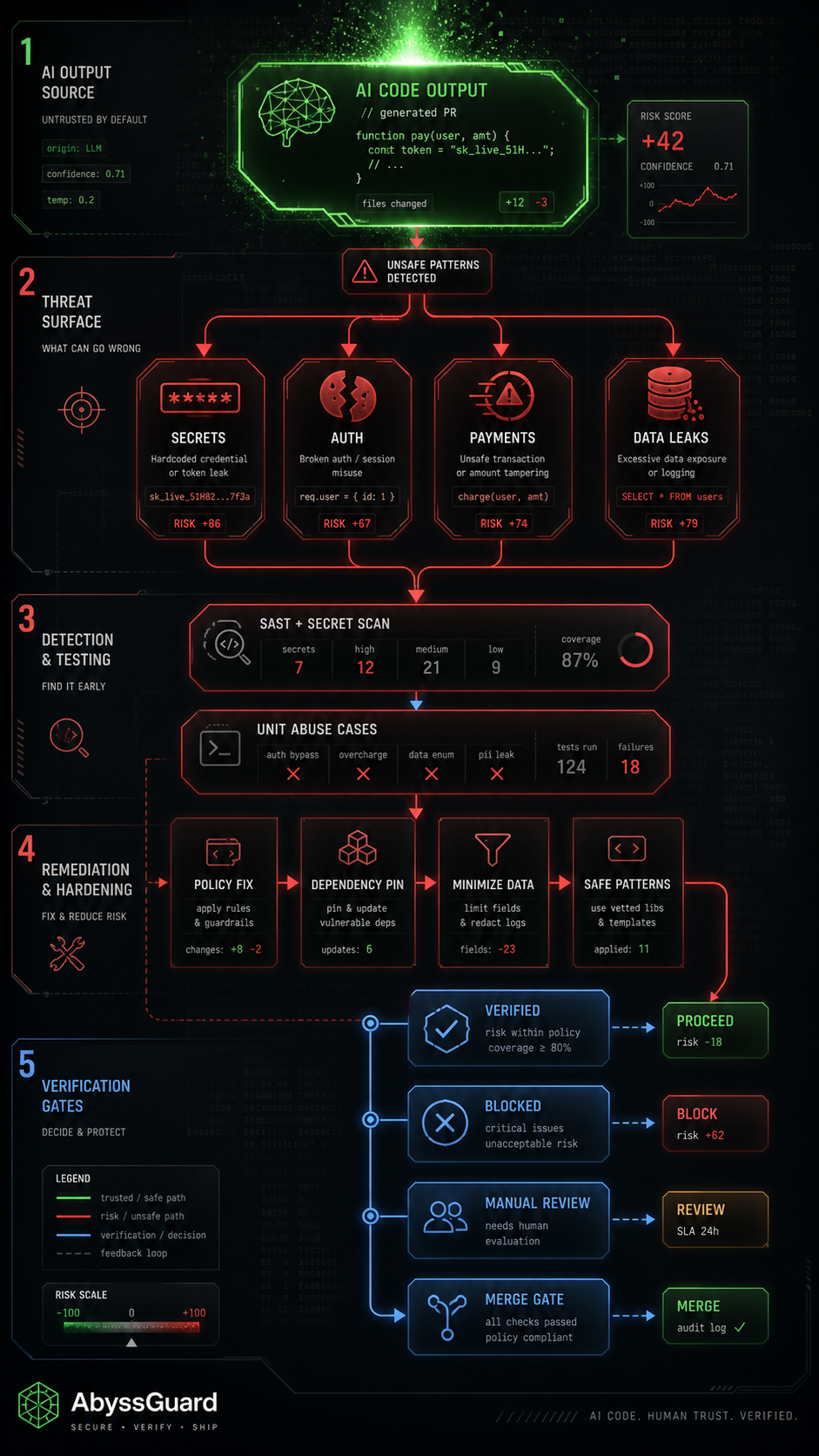
AI-built products do not fail because the idea was bad. They fail because the code moved faster than the review system around it. AI Generated Code Security Risks is the kind of risk a launch team should turn into a practical review workflow, not a generic SEO page.
Key Takeaways
- AI Generated Code Security Risks usually appears where AI-generated code touches auth, payments, webhooks, secrets, dependencies, or deployment automation.
- The dangerous part is not that AI wrote the code. The dangerous part is shipping without a repeatable evidence loop.
- AbyssGuard turns the review into a launch-readiness artifact: findings, severity, repair steps, and proof a founder can act on.
Table of Contents
- Why this risk shows up in AI-built apps
- What to check before launch
- How AbyssGuard turns it into a workflow
- Frequently asked questions
Why this risk shows up in AI-built apps
AI Generated Code Security Risks becomes urgent when a team is moving from prototype to customer-facing software. AI coding tools are excellent at filling in routes, forms, handlers, SDK calls, and glue code. They are less reliable at preserving the hidden contract between security, product logic, and infrastructure.
The result is often a product that feels complete in the browser but still trusts the client, skips a webhook signature, leaves a privileged route exposed, or stores a secret in the wrong place. That gap is exactly where founders lose trust after launch.
The common pattern
A founder asks an agent to build quickly. The agent creates working features. The team tests the happy path. Nobody checks the negative path. ai generated code security risks lives in that negative path.
What to check before launch
- Authentication: Verify protected routes are protected server-side, not only hidden in the UI.
- Authorization: Confirm one user cannot access another user's project, report, billing state, or private repository data.
- Payments: Treat every price, plan, and entitlement value from the browser as untrusted.
- Webhooks: Verify signatures and replay behavior before accepting payment or provider events.
- Secrets and dependencies: Scan the repository and deployment config before the first public push.
How AbyssGuard turns it into a workflow
AbyssGuard is useful because it does not stop at a scary list. The output needs to answer three founder-level questions: what is exposed, what matters first, and what change proves the product is safer.
The workflow is simple: connect the repository, run the scan, review prioritized findings, apply the repair packet, and keep monitoring as AI-generated code changes. That gives the team a security habit instead of a one-time panic.
Review your repository with AbyssGuard before the next AI-generated change ships.
Frequently Asked Questions
Is ai generated code security risks only a problem for teams using AI agents?
No. Traditional teams ship similar bugs. AI just compresses the timeline, which means the review loop has to be tighter.
Should founders wait until after launch to scan?
No. Scan before launch, then keep scanning after meaningful changes. Waiting until traffic arrives means users become the test environment.
What should a good report include?
Evidence, severity, affected files or flows, repair guidance, and a clear path to verify the fix. A vague warning is not enough.