AI Code Review Checklist for SaaS Launches
Table of Contents
AI-assisted SaaS teams can ship a working product before the security review process has caught up. That speed is useful, but it creates a simple pre-launch question: did anyone check the risky paths, or did the team only test the happy path?
Key Takeaways
- A pre-launch review should focus on authorization, payments, webhooks, secrets, dependencies, and deployment settings.
- The goal is not to prove that AI-generated code is bad. The goal is to prove the product can handle abuse, mistakes, and edge cases.
- AbyssGuard turns the checklist into evidence founders can act on before customers, investors, or app reviewers see the product.
Table of Contents
- Why AI-built SaaS needs a checklist
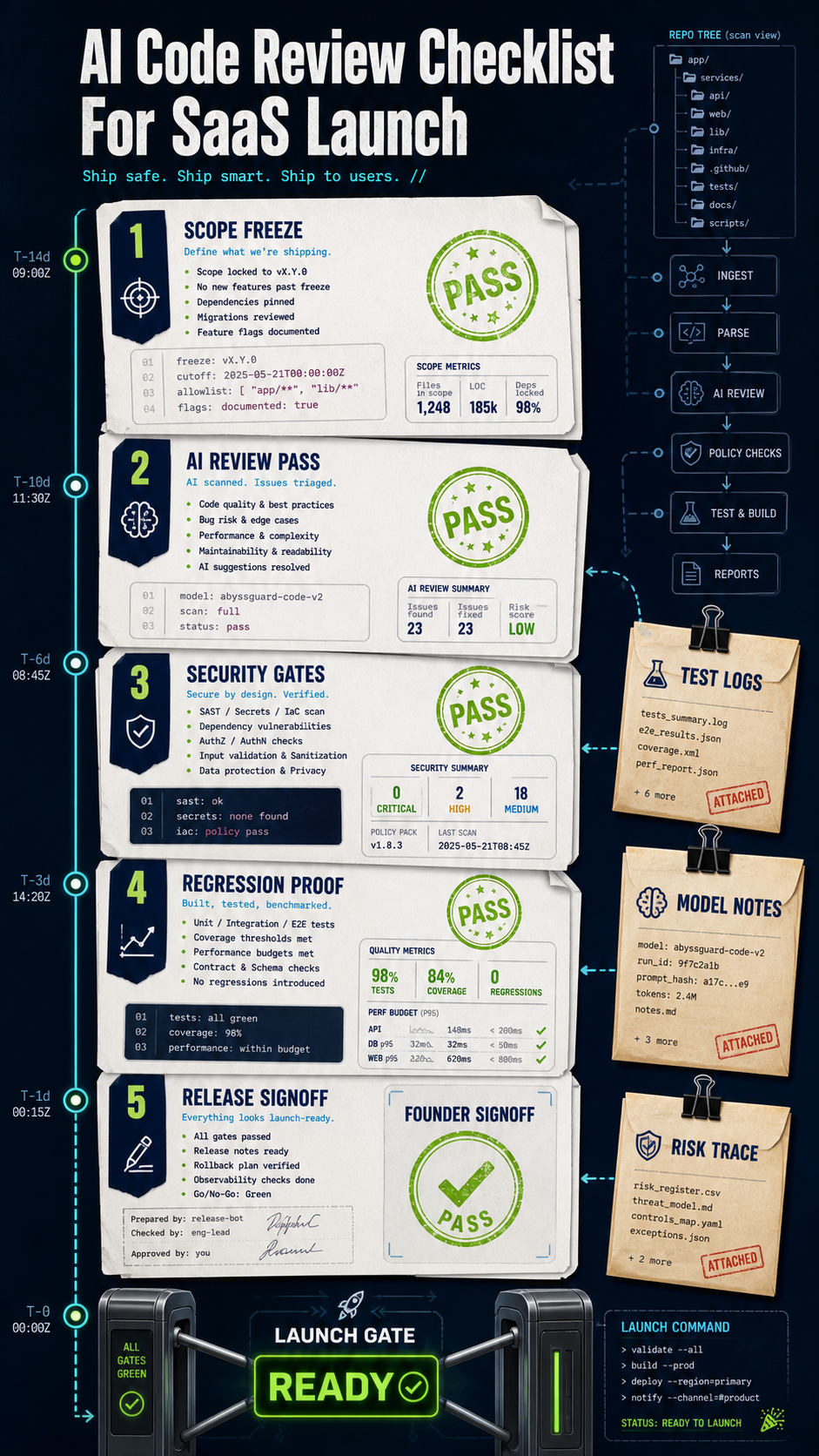
- The pre-launch review sequence
- What founders should fix first
- How AbyssGuard supports the workflow
- Frequently asked questions
Why AI-built SaaS needs a checklist
AI coding tools are strongest when the request is clear and the path is common: create a route, connect a form, call an API, write a webhook handler, or add a dashboard. Security failures usually live outside that happy path. They show up when one user tries to access another user's data, when a browser request edits a price, when a webhook is replayed, or when a private token appears in a build artifact.
That is why a checklist matters. It gives a small team a repeatable way to inspect the product before launch. It also keeps the review concrete. Instead of asking whether the code is secure in general, the team checks the specific places where fast SaaS builds tend to break.
The pre-launch review sequence
Start with identity and permissions. Every protected page should be protected on the server, not only hidden in the sidebar. Every account, project, scan, report, invoice, and private repository should be tied to a verified owner. If a user changes an ID in the URL or request body, the server should reject access unless that user owns the resource.
Next, review money movement. Checkout, plan selection, entitlements, usage counters, and credits must be treated as server-owned facts. The browser can display a price or chosen plan, but it should not be trusted as the source of truth. Webhook events should verify signatures and handle replay safely before changing account access.
Then check secrets and integration settings. AI-generated code often wires SDKs quickly. That can leave server keys in client bundles, logs, local fixtures, or public examples. Search for provider tokens, private keys, OAuth secrets, webhook secrets, and database credentials before shipping.
Finally, inspect dependencies and deployment. A product can look polished while still relying on vulnerable packages, broad permissions, or an environment mismatch between local and production. The review should include package risk, container or hosting configuration, security headers, and the production route behavior that real users will hit.
What founders should fix first
Fix anything that crosses account boundaries first. Broken authorization is more dangerous than rough UI copy because it can expose customer data. Payment and entitlement bugs come next because they can create revenue loss, account confusion, or support debt. Exposed secrets and unsafe webhooks should also be treated as launch blockers.
Lower-severity issues still matter, but they should not drown the founder in noise. A useful review ranks problems by exploitability, business impact, and how directly they affect trust. The best pre-launch checklist ends with a short repair queue, not a hundred vague warnings.
How AbyssGuard supports the workflow
AbyssGuard is built for the founder who needs proof before launch. The workflow is straightforward: connect the repository, run a scan, review prioritized findings, apply the repair packet, and keep monitoring as the product changes. That turns security review into an operating habit instead of a one-time panic.
The important part is evidence. A founder should be able to see which file, route, dependency, or integration created the risk. They should also know what to fix next and how to verify the fix. That is the difference between a checklist that feels responsible and a scanner that only creates anxiety.
Frequently asked questions
Is this only for AI-generated code?
No. The same checklist helps any fast SaaS build. AI-generated code makes the review more urgent because teams can create more surface area in less time.
Should this happen before or after launch?
Both. Run the first review before launch, then repeat it when you add payment flows, private data, repository access, AI features, or new deployment automation.
What is the minimum review for a small founder?
Check authorization, payment trust boundaries, webhook verification, secret exposure, dependency risk, and production-only route behavior. That minimum catches many of the mistakes that hurt early-stage products.